Duplex, Fourplex, or 8-Plex: Sizing Your First Rental Construction Project
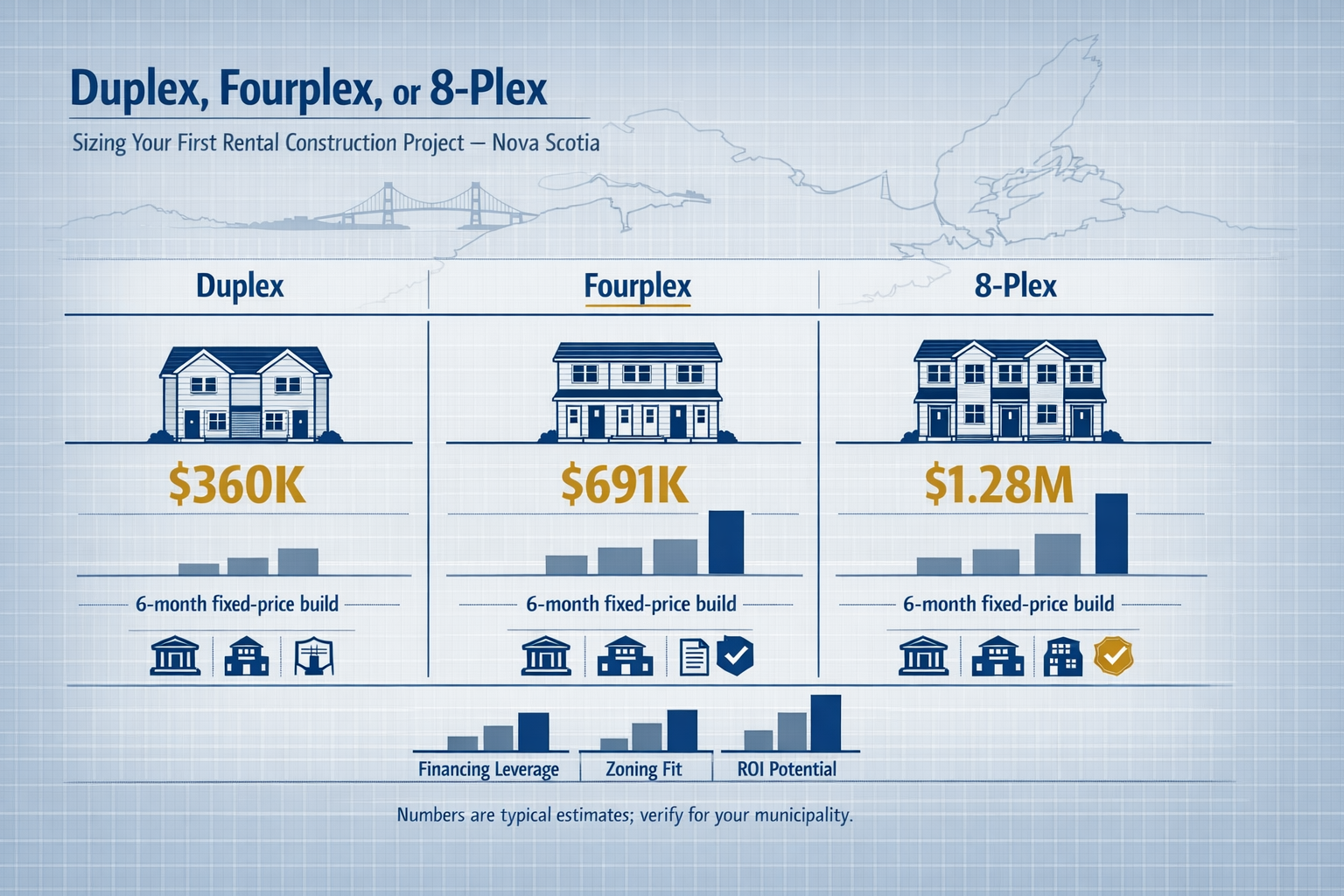
If you're considering your first rental construction project in Nova Scotia, you're likely asking: should I build a duplex, a fourplex, or an 8-plex? Each option comes with its own costs, financing requirements, and zoning hurdles. For example, building a duplex in Halifax costs about $359,824, while a fourplex starts at $691,200. An 8-plex, the largest option, requires $1.28 million or more. Financing terms differ too: duplexes and fourplexes qualify for residential mortgages with 20% down, but an 8-plex falls under commercial financing, requiring 25–35% equity. With Halifax's rental vacancy rate at just 1% and average two-bedroom rents hitting $1,538 per month in 2023, demand is strong across the board.
This article will break down construction costs, financing details, zoning requirements, and expected returns for each option to help you decide which project size best fits your budget, risk tolerance, and goals.
Duplex vs Fourplex vs 8-Plex: Construction Costs, Financing & Returns Comparison
1. Duplex
Construction Costs
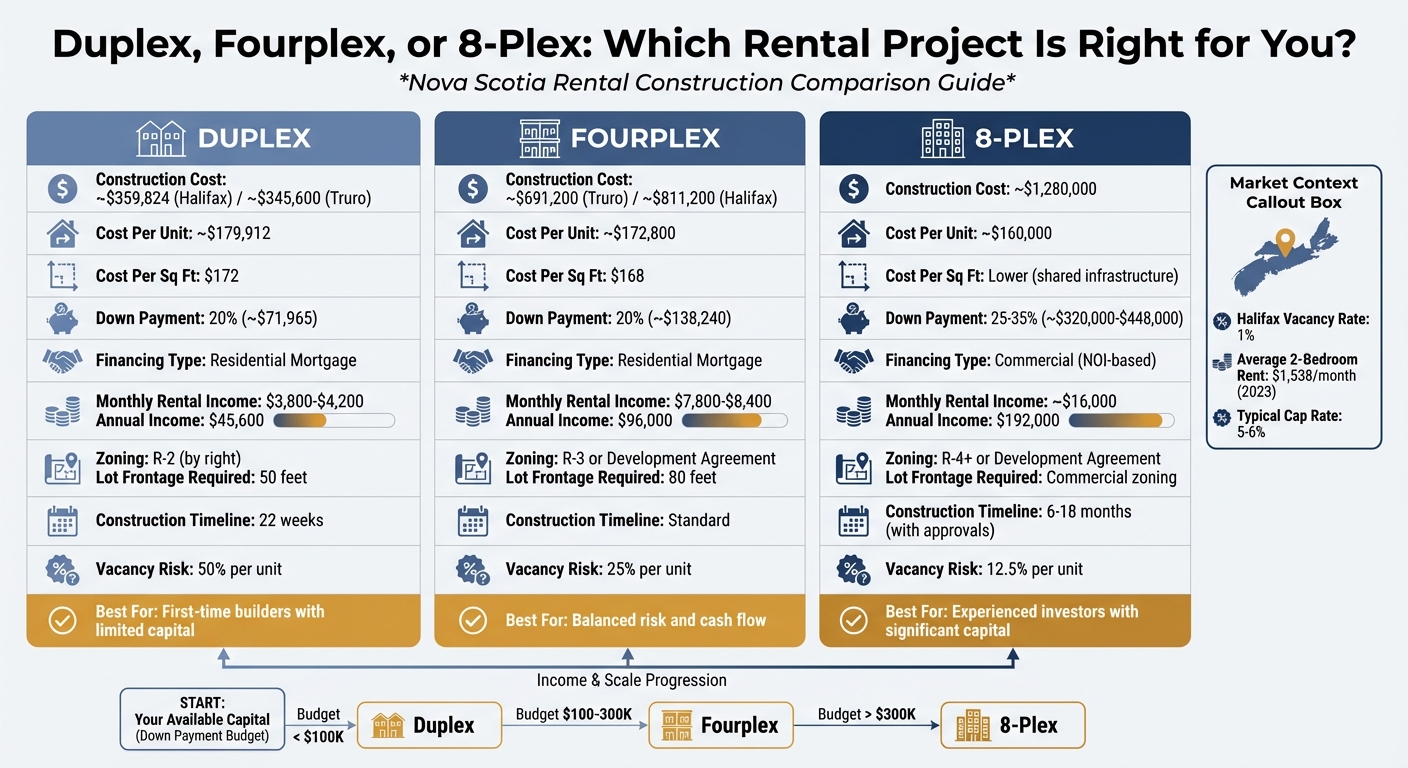
In Halifax, building a pre-designed duplex of about 2,092 square feet costs approximately $359,824. That works out to $172 per square foot, or roughly $179,912 per unit - a relatively affordable entry point for first-time builders [1]. If you’re considering building in areas outside Halifax, such as Truro, you can expect costs to drop by about 15% due to a lower cost multiplier (0.85 for labour and materials). This reduction brings the total to around $345,600, saving more than $14,000 while still tapping into the Halifax rental market and surrounding regions [6].
Once you’ve nailed down construction costs, the next step is to evaluate your financing options.
Financing Options
For duplexes that aren’t owner-occupied, lenders generally require a 20% down payment on a construction mortgage. On a $359,824 build, this means you’ll need to put down about $71,965 upfront [3]. During the construction phase, you’ll typically make interest-only payments until the project is completed and passes final inspections [3].
Once the duplex is built and rented - targeting rents of approximately $1,900 per month per three-bedroom unit - the property could be appraised at its completed value using a 6% cap rate. This could result in $210,000 in immediate equity, depending on market conditions [1][2].
After financing, zoning and permitting are critical to ensuring the project runs smoothly.
Zoning and Permitting
Duplexes in Nova Scotia benefit from relatively straightforward zoning rules. In Halifax, most R-2 residential zones allow two units "by right", so you can avoid the lengthy rezoning processes often required for larger developments [3]. Generally, you’ll need a minimum of 50 feet of street frontage for the lot [3]. For builders in Truro, permit fees are notably low - around $0.06 per square foot, which translates to about $240 for a 4,000-square-foot duplex project [6]. From start to finish, the construction timeline for a duplex typically spans 22 weeks [1].
Projected Returns
Renting out both units at approximately $1,900 per month generates a monthly income of $3,800 or $45,600 annually [1]. However, losing one tenant would result in a 50% income drop, which underscores the importance of maintaining strong occupancy. Fortunately, high rental demand in the region helps offset this risk.
sbb-itb-16b8a48
2. Fourplex
Construction Costs
If you're new to building and want to scale efficiently, understanding how fourplexes work is key. In Nova Scotia, fourplexes offer a cost-effective way to expand. For instance, in Truro, constructing a fourplex starts at approximately $691,200, or $172,800 per unit. In Halifax, where labour and materials are about 15% pricier, you’re looking at an additional $100,000–$120,000 on top of that base cost[6]. These savings come from shared walls and consolidated mechanical systems, which reduce overall expenses. Using standardized, pre-designed layouts can further keep construction costs manageable, around $168 per square foot[1][3].
This shared infrastructure significantly lowers per-unit costs compared to building duplexes separately, making it easier to secure favourable financing.
Financing Options
One of the big advantages of a fourplex is that it qualifies for residential mortgages, which means you avoid the larger down payment required for commercial loans. For example, if you’re building a fourplex in Truro for $691,200, your 20% down payment would be about $138,240[3][5]. Once the property is rented - aiming for $2,000 per unit per month, or $8,000 total monthly rent - it’s often appraised based on its income. Using a cap rate of 5% to 6%, this income-based valuation can generate immediate equity, which you can tap into through refinancing[1][2].
Zoning and Permitting
While the financials look good, zoning and permitting require careful planning. In Halifax, for instance, R-2 zones permit two units by default, but a fourplex usually requires R-3 zoning or a development agreement. This can stretch your pre-construction timeline[3][6]. Fourplexes also need 80 feet of street frontage, compared to the 50 feet typically sufficient for a duplex. In Truro, permit fees are more straightforward - about $0.06 per square foot. For an 8,000-square-foot project, that’s roughly $480 in fees[6].
Projected Returns
With $8,000 in monthly rental income, a fourplex generates $96,000 annually in gross revenue - more than double the $45,600 you’d typically see from a duplex[1][6]. Plus, the risk of vacancy is lower: losing one tenant in a fourplex means a 25% income drop, whereas a duplex vacancy slashes your income by 50%[4]. While operating expenses - like insurance, taxes, and maintenance - may eat up a larger share of the income in a fourplex, the net cash flow is still much stronger. On average, a fourplex delivers about 73% more net income than a duplex, despite its higher gross rent[4].
3. 8-Plex
Construction Costs
Building an 8-plex offers cost efficiencies that smaller projects simply can't match. In Nova Scotia, Helio estimates the construction cost at CA$1,280,000 (8 units × CA$160,000 per unit), though site conditions and design choices can affect the final price. For comparison, turnkey 8-unit buildings in Halifax's North End were listed at CA$3,840,000 as of February 2026, while renovated downtown properties sold for CA$2,995,000[7]. The savings per unit become clear when you factor in shared infrastructure like mechanical systems, roofing, and foundation work - these costs are divided across more units, lowering the per-unit expense. However, keep in mind additional soft costs, which typically add about 3% to the total, as well as any site-specific expenses like upgraded utility connections[2].
Financing Options
For properties with 5 or more units, banks use Net Operating Income (NOI) to determine value, rather than comparable sales[2]. This method often results in immediate equity gains. For example, an 8-plex generating CA$16,000 in monthly rent (approximately CA$2,000 per unit) produces CA$192,000 annually. With a 5% cap rate, the building's value is calculated at CA$3,840,000. Construction financing typically covers 80% of the project cost, requiring you to put down 20% upfront. After construction, permanent mortgages are generally capped at either 70% loan-to-value or 1.25× debt service coverage, whichever is lower[2].
If your project meets affordability and energy efficiency benchmarks, you might qualify for CMHC MLI Select financing, which can reduce your down payment to as little as 6%[7]. In this segment of the market, the building's income - not its size - determines its value.
Zoning and Permitting
Most Nova Scotia municipalities require commercial zoning for an 8-plex, which often involves obtaining development agreements or securing an R-4 designation (or higher), particularly in areas like Halifax. This step can add 3–6 months to your pre-construction timeline compared to smaller projects[2]. However, using pre-approved layouts can significantly shorten the build cycle, reducing the industry average of 18 months to around 6 months[2].
Nova Scotia's Housing Minister John White has emphasized flexibility in multi-unit construction methods:
All options are on the table, for sure. So stick framing or modular [units], whichever comes back that provides the best value for the province will be what we'll choose[8].
These zoning and permitting nuances are critical to understanding the timeline and feasibility of an 8-plex project.
Projected Returns
With gross annual rent of CA$192,000, an 8-plex offers a strong cash flow opportunity. After accounting for typical operating expenses (about 25% of gross rent) and a 2% vacancy allowance, the property could generate approximately CA$141,120 in Net Operating Income (NOI) each year[2]. By comparison, a fourplex would bring in roughly CA$96,000 in gross revenue, meaning the income potential doubles with an 8-plex.
That said, managing an 8-plex comes with added complexity. Losing one tenant results in a 12.5% income drop, compared to 25% for a fourplex or 50% for a duplex. Additionally, handling multiple households, appliances, and maintenance needs can be challenging. For first-time builders, this scale often requires either full-time self-management or hiring professional property management, which typically costs 8–10% of gross rent. Balancing these factors is key to determining whether an 8-plex aligns with your investment goals.
Duplex vs 4 Plex’s! Which one is easier and makes more money?
Advantages and Disadvantages
When weighing your options, it’s a balancing act between upfront costs, financing terms, and long-term income. A duplex is the most affordable entry point, with an initial investment of roughly CA$320,000 (assuming a 20% down payment and R-2 zoning). However, losing one tenant slashes your income by 50%. A fourplex, on the other hand, doubles your earning potential - bringing in CA$7,800 to CA$8,400 monthly - while still qualifying for residential mortgage terms. The trade-off? You’ll need at least 80 feet of street frontage and deal with slightly more complex property management.
An 8-plex maximizes cash flow, generating about CA$16,000 per month and spreading vacancy risk across eight units. But it comes with its own challenges: commercial financing (requiring a 25–35% down payment), stricter zoning hurdles, and longer timelines for approvals.
Here’s a quick breakdown of the financial and regulatory considerations for these three options:
| Factor | Duplex | Fourplex | 8-Plex |
|---|---|---|---|
| Construction Cost | ~CA$320,000 | ~CA$640,000 | ~CA$1,280,000 |
| Cost Per Unit | ~CA$160,000 | ~CA$160,000 | ~CA$160,000 |
| Down Payment | 20% (Residential) | 20% (Residential) | 25–35% (Commercial) |
| Monthly Rental Income | ~CA$3,900–4,200 | ~CA$7,800–8,400 | ~CA$16,000 |
| Zoning Complexity | Low (R-2 by right) | Moderate (80ft+) | High (Development agreements) |
| Vacancy Risk | 50% per unit | 25% per unit | 12.5% per unit |
These numbers highlight the trade-offs. If you’re working with a smaller budget and prefer straightforward approvals, a duplex or fourplex keeps things simpler and within residential financing. But if you have the financial capacity to navigate commercial lending and zoning challenges, an 8-plex offers stronger cash flow and better risk distribution per unit. The right choice depends on your capital, risk tolerance, and how much complexity you’re ready to take on.
Conclusion
Looking at the construction, financing, and zoning details outlined earlier, the right project size depends on your capital, risk tolerance, and cash flow needs. Whether it's a duplex, fourplex, or 8-plex, each option has its pros and cons.
A duplex is the least capital-intensive, benefiting from simpler R-2 zoning and residential financing. It’s a good entry point for those with limited funds but comes with higher income risk since you’re reliant on just two units.
A fourplex, costing around CA$640,000 to build, offers a balance. It spreads vacancy risk across four units and still qualifies for residential financing. With monthly rental income of CA$7,800–CA$8,400, it’s a solid step up from a duplex without jumping into the complexities of commercial financing.
An 8-plex, on the other hand, requires commercial financing, typically with a 25–35% down payment, and involves development agreements. It’s the most expensive choice but delivers the strongest cash flow - around CA$16,000 monthly. This setup reduces vacancy risk to just 12.5% per unit. In Halifax’s current market, with vacancy rates sitting at 1% and average two-bedroom rents at CA$1,538 per month [3], an 8-plex could also benefit from income-based valuations, helping you build equity faster.
For property owners, the decision boils down to your available capital and financing preferences. If you have CA$80,000–CA$100,000 for a down payment and prefer straightforward financing, a duplex or fourplex is a practical choice. If you’re working with CA$320,000 or more and are comfortable with commercial lending terms, an 8-plex offers better cash flow and spreads out risk.
Before committing, double-check your lot’s frontage and ensure municipal water and sewer access. Don’t overlook the HST rebates - a six-unit build could return over CA$200,000 [2]. The key is picking a project size that matches your financial capacity, risk appetite, and timeline.
FAQs
Which project size fits my budget best?
Your project's scale should align with both your financial capacity and your objectives. For example, a duplex is the least expensive option, with construction costs averaging $320,000 and generating monthly rental income between $3,900 and $4,200. If you're aiming for higher earnings, a fourplex might be a better fit. It costs approximately $640,000 to build and can bring in $7,800 to $9,600 per month in rent.
Smaller builds are often more economical, with fixed-price construction rates starting at $168 per square foot. On the other hand, larger projects, like 8-plexes, demand more upfront investment and detailed planning but come with the potential for significantly higher income.
How do I qualify for CMHC MLI Select?
To apply for CMHC MLI Select, your project must align with the program's specific criteria. This includes meeting standards for rent affordability, addressing local market demand, and achieving energy efficiency benchmarks. Lenders assess applications using a point-based system, so it's crucial to present thorough plans, precise budgets, and showcase capable management that reflects the needs of the local rental market.
What lot frontage do I need in Halifax?
In Halifax, if you're planning to build up to 4 units, you'll generally need a minimum lot size of 8,000 square feet. The exact frontage requirements - whether measured in metres or feet - will depend on the lot's shape and its specific zoning designation. Additionally, keep an eye on setback and side yard regulations, as these zoning rules will dictate how much space you need to leave between your building and the property lines.