The Hidden Costs of Buying Existing Rental Property vs. Building New
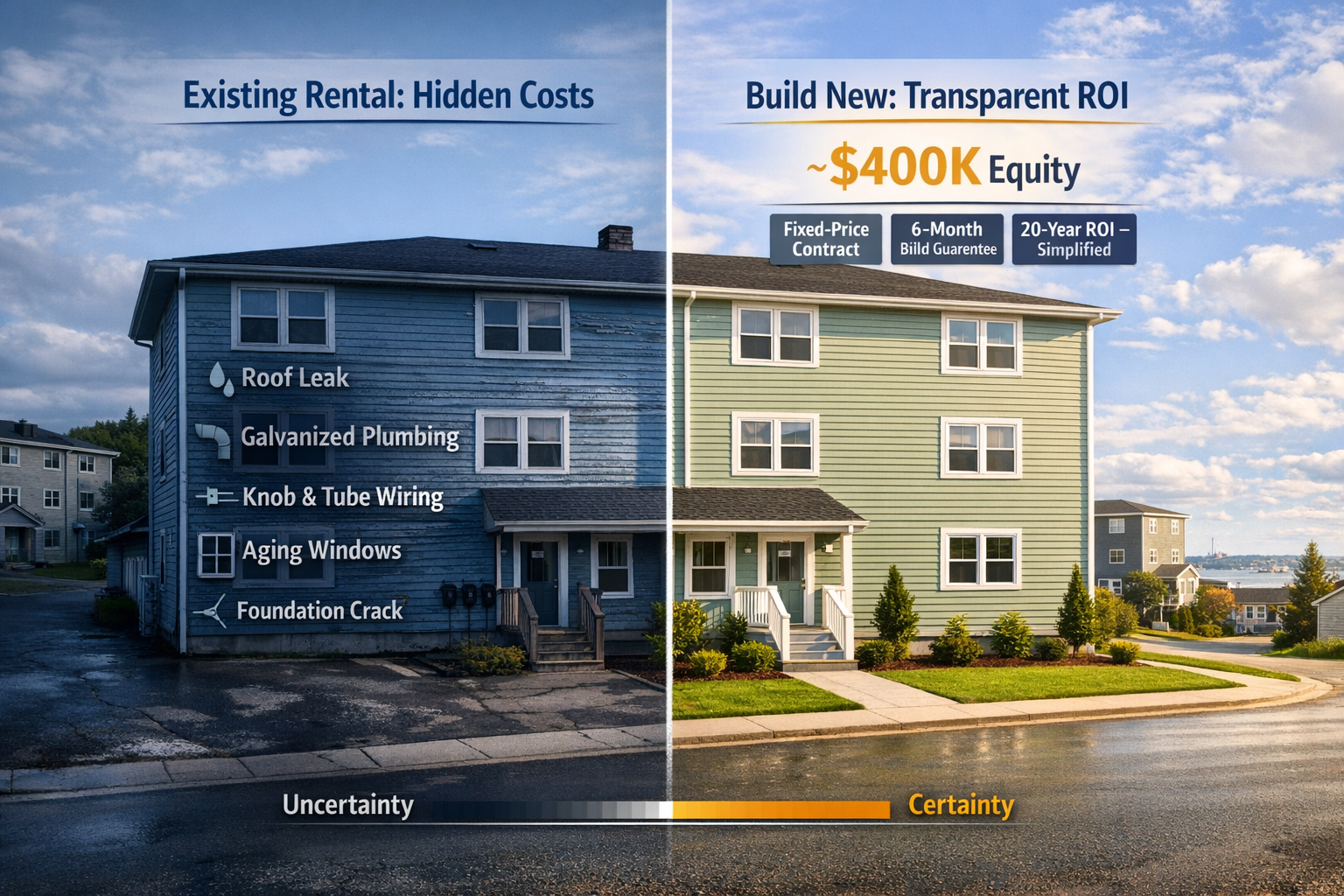
If you're debating whether to buy an existing rental property or build new in Nova Scotia, you're likely weighing upfront costs against long-term returns. On the surface, buying seems simpler - rental income starts right away, and you avoid the headaches of construction. But older properties often come with unexpected repair bills, outdated systems, and compliance upgrades that can drain your cash flow. Building new, while requiring more planning, offers predictable costs, modern energy efficiency, and the potential to create equity immediately. For example, a 6-unit build costing $1.7M can generate $400,000 in equity at completion, compared to buying an older property at market rates with no room for surprises.
This article breaks down the numbers and risks of both options to help you decide which approach aligns with your financial goals over the next 20 years.
Buying vs Building Rental Property: 20-Year Cost Comparison
Old vs New Rental Property: Which Is A Better Investment?
sbb-itb-16b8a48
Upfront Costs: Purchase vs. Build
Upfront costs go beyond just the purchase price or construction quote - there are always additional expenses before rental income starts flowing. Let’s break down these costs for both buying existing properties and building new ones.
Buying Existing: Purchase Price and Closing Costs
When you buy an existing multi-unit property in Nova Scotia, the price you pay reflects market demand and often includes a premium for a "ready-to-use" asset. While this approach skips construction timelines, you’re essentially paying for someone else’s equity and could inherit deferred maintenance issues. On top of the purchase price, closing costs add up quickly. These include legal fees, title insurance, deed transfer tax, and inspection costs, which may uncover immediate repairs or compliance issues.
The bigger challenge is that you’re buying at market rates tied to current rental income, leaving little room to adjust for surprises. Ageing systems, outdated code compliance, or poor energy efficiency can lead to unexpected renovation costs - often within the first year. These expenses are rarely included in your initial investment calculations but can significantly impact your returns.
Building New: Land and Site Preparation Costs
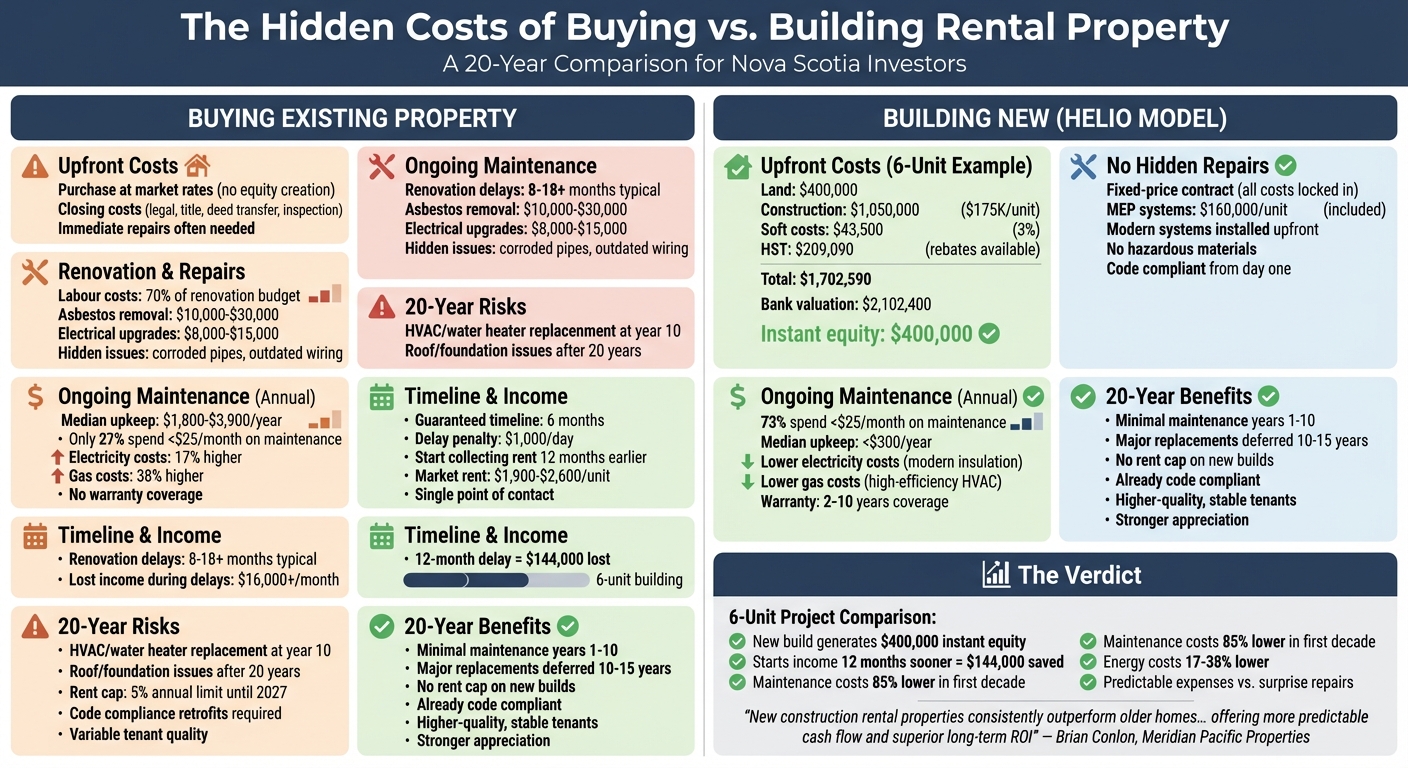
Building new involves land acquisition and construction costs, but it also allows you to create equity upfront. For instance, a 6-unit project with a total cost of $1,702,590 - broken down into $400,000 for land, $1,050,000 for construction ($175,000 per unit), $43,500 in soft costs, and $209,090 in HST - can yield a bank valuation of $2,102,400. That’s nearly $400,000 in equity created right away [4]. However, the HST is a significant upfront expense, though government rebates can help offset some of it.
Site-specific costs are the most unpredictable part of new construction. Expenses like rock removal, extended utility trenching, or private well and septic systems can add $10,000–$25,000 beyond the base construction quote [2][3]. Soft costs - such as architectural design, structural engineering, and municipal permits - typically make up about 3% of the total project cost [4]. Traditional construction models often lead to coordination challenges, adding up to 30% in budget overruns [1]. By contrast, integrated design-build models lock in these costs from the start, avoiding the inconsistent invoicing that often derails traditional projects.
Renovation and Repair Expenses
Owning an older rental property often comes with a host of hidden costs. Many older buildings conceal outdated electrical wiring, deteriorating plumbing, and aging HVAC systems that can compromise safety and functionality. These issues usually demand immediate attention, leading to unpredictable expenses. This makes upgrading aging systems a critical consideration.
Upgrading Aging Systems
In older properties, mechanical, electrical, and plumbing (MEP) upgrades are among the most expensive renovation tasks. Labour alone can account for up to 70% of renovation costs, compared to about 30% in new builds[7]. Initial repairs often uncover additional problems such as corroded pipes, knob-and-tube wiring, termite damage, or weak framing, all of which can quickly inflate costs[5].
New construction avoids these surprises entirely. With a fixed-price design-build approach, MEP system costs are locked in, providing predictable expenses and returns. For example, modern MEP systems, complete with ductless heat pumps, heat recovery ventilators (HRVs), and dedicated hot water tanks, start at $160,000 per unit[1]. These systems are installed upfront, ensuring efficiency and compliance from the beginning.
Code Compliance and Hazard Removal
Bringing older buildings up to current safety codes is unavoidable. Many older properties fail to meet modern electrical, plumbing, and disaster resilience standards[8]. Renovations often require asbestos abatement, which can cost between $10,000 and $30,000, or electrical panel upgrades ranging from $8,000 to $15,000[8]. If your property contains chrysotile asbestos - banned for new use starting in 2024 - any disturbances during renovations will likely trigger mandatory abatement. Similarly, properties with lead-based paint, common in pre-1980s buildings, face additional challenges since its ban in 1978[8].
These compliance upgrades significantly add to renovation costs and are often unavoidable. By contrast, new builds meet modern safety standards right from the start. This eliminates the risk of dealing with hazardous materials and unexpected compliance costs, making new construction a more predictable and risk-averse investment.
Ongoing Maintenance Costs
Older rental properties often come with higher maintenance demands, which can significantly affect cash flow.
Repair Frequency and Costs
Older properties tend to need more frequent repairs. For instance, 73% of owners with newly built properties report spending less than $25 per month on routine maintenance. In contrast, homes built before 1950 have a median annual upkeep cost of $1,800. For new owners, this figure can climb to $3,900 annually, compared to $1,500 for those who've owned their properties longer [6][8][10].
As a general rule, budget at least $200 annually per 500 sq ft for routine maintenance. For a 6-unit building with 1,000 sq ft per unit, that’s about $2,400 a year - just for routine upkeep. This estimate doesn’t include major repairs or system failures [10].
Newly constructed properties help mitigate these risks. They often include builder warranties covering major systems for five to ten years [6][9]. This kind of predictability lets you plan for operating expenses - usually around 25% of gross rental income for new builds [4] - without the stress of unexpected repair costs.
“In a new build, your maintenance tasks might be as simple as changing HVAC filters or touching up caulk.”
- Garrett Brown, short-term rental expert at BiggerPockets [6]
Energy Efficiency and Utility Expenses
Older properties also tend to drain more money on utilities. Owners of older rentals pay 17% more for electricity and 38% more for gas annually compared to owners of newer properties [8]. These higher costs are often due to outdated insulation, single-pane windows, and inefficient heating systems.
New construction adheres to modern energy codes - or surpasses them - with features like triple-pane windows and ductless heat pumps. These upgrades lower energy consumption. According to the U.S. Department of Energy:
“Energy-efficient homes place less stress on mechanical systems, which can extend their lifespan and reduce repair costs - while also lowering monthly utility bills” [9].
Whether you pay utilities yourself or pass the cost to tenants, energy-efficient properties can command higher rents and attract tenants who value lower utility bills.
| Feature | Older Rental Property | New Construction Rental |
|---|---|---|
| Routine Maintenance | ~27% of owners spend <$25/month | 73% of owners spend <$25/month [6][8] |
| Annual Upkeep (Median) | $1,800 (new owners up to $3,900) [10] | Often <$300 |
| Electricity Costs | 17% higher than average [8] | Lower due to modern insulation |
| Gas Costs | 38% higher than average [8] | Lower due to high-efficiency HVAC |
| Major System Warranty | Typically none | 5–10 years [6] |
Construction Timelines and Lost Income
Renovation timelines can be a hidden drain on your investment returns, especially when delays stretch out vacancy periods. These delays not only disrupt cash flow but also increase holding costs, eating into your bottom line.
Renovation Delays and Vacancy Periods
When management is fragmented, delays become inevitable. Misaligned designs, permit rejections, and poor coordination can turn an 8-month renovation into an 18-month ordeal - or worse. Add in weather, material shortages, and labour disruptions, and the timeline spirals out of control [1].
The financial hit is undeniable. Every month of delay costs over $16,000 in lost rent and carrying costs [1]. For a 6-unit building, a 12-month delay translates to a staggering $144,000 in lost income [4]. On top of that, renovation expenses incurred before the property generates rental income must be capitalized, deferring your ability to claim deductions [11][12].
Switching to an integrated approach can prevent these costly setbacks.
Fixed Timelines with Helio
Helio’s integrated design-build model eliminates the chaos that causes delays. This approach ensures a streamlined process, reducing lost income and protecting your returns. Helio guarantees a 6-month timeline, with penalties of up to $1,000 per day for delays [1].
"Our AI scheduling system prevents the delays that killed our first project."
- Yuan He, Co-Founder & CTO, Helio Urban Development [1]
With a single team working under one contract, progress remains steady and predictable [1][2]. Pre-designed layouts, such as the Birchwood Triplex or Sprucewood Duplex, typically take around 22 weeks to complete under normal conditions [3]. This reliability allows you to start collecting market rents - ranging from $1,900 to $2,600 per unit in Nova Scotia - on time, helping you transition quickly from construction loans to permanent financing and cash flow positivity [1][3].
| Factor | Traditional Renovation/Build | Helio Fixed Timeline |
|---|---|---|
| Typical Timeline | ~18 months [1][4] | 6 months (guaranteed) [1][4] |
| Monthly Lost Rent | ~$8,800 [1] | Income starts 12 months earlier |
| Monthly Carrying Costs | ~$8,000 [1] | Minimized by rapid delivery |
| Delay Protection | None (owner bears all risk) | Up to $1,000/day [1] |
| Management | Multiple invoices/professionals | Single point of contact [1] |
Helio's approach keeps your project on track, ensuring you avoid the financial pitfalls of extended timelines. Instead of juggling multiple contractors and delays, you get a clear path to completion and a faster return on your investment.
20-Year ROI and Risk Comparison
When weighing the choice between purchasing an existing rental property or constructing a new one, a 20-year perspective highlights clear differences in returns and risk exposure. While existing properties often come with lower initial costs, new builds typically deliver better long-term appreciation and more predictable cash flow.
Property Value Growth and Rental Income
From 2021 to 2025, Nova Scotia's housing market saw a 53.1% rise in average home prices[13]. While market growth is expected to slow as conditions stabilize, new builds make better use of land by adhering to proper zoning and density regulations, avoiding the "lost equity value" associated with under-utilized properties[1].
For existing properties, a 5% annual rent cap remains in place until 2027, limiting income growth even as expenses increase[14]. New builds, on the other hand, can set initial rents at market rates - ranging from $1,900 to $2,250 per month for a two-bedroom unit with modern finishes. These units often attract higher-quality tenants who pay on time and stay longer[1][16]. For example, a new build generating $2,100 monthly rent per unit produces nearly 28% more income compared to Halifax's average rent of $1,636[15]. Over time, this rental premium significantly boosts overall revenue and reduces risk exposure.
Risk Factors: Unexpected Repairs and Regulatory Changes
Existing properties come with the likelihood of frequent system failures - HVAC units and water heaters typically need replacing around year 10, while roofs and foundations often require attention after 20 years[16]. These unplanned expenses can eat into profits and disrupt cash flow.
New construction minimizes these risks through builder warranties, which often cover structural and system defects for one to ten years, and compliance with modern building codes that reduce long-term wear and tear[16]. For instance, Helio offers a 2-year warranty covering both structural and system issues, while energy-efficient features like triple-pane windows and heat pumps lower utility costs from the start[1]. Additionally, new builds sidestep many regulatory hurdles; older properties may require costly retrofits to meet updated codes and zoning laws[1][16].
| Risk Factor | Existing Property | New Construction |
|---|---|---|
| Maintenance (Years 1–10) | High; frequent repairs needed[16] | Minimal; covered by warranties[16] |
| Major System Replacement | Around year 10 (HVAC, water heaters)[16] | Deferred 10–15 years[16] |
| Code Compliance Risk | High; potential retrofitting costs[1] | Low; built to current standards[16] |
| Tenant Quality | Variable; higher turnover risk[16] | Higher-income; more stable tenants[16] |
| Appreciation | Variable; depends on renovation quality[16] | Stronger, more predictable growth[16] |
In summary, existing properties often carry higher risks tied to repairs and compliance, while new builds provide a more stable and controlled investment over the long term.
"New construction rental properties consistently outperform older homes and fixer-uppers... offering a more predictable cash flow and superior long-term ROI compared to older properties, which often come with hidden costs and structural uncertainties" - Brian Conlon, Director of Business Development at Meridian Pacific Properties[16]
Conclusion
Data shows that hidden repair, maintenance, and compliance costs can eat into the perceived savings of owning older rental properties. Helio's model addresses these issues with fixed pricing, a guaranteed 6-month timeline, and a 2-year warranty - removing the uncertainty of hidden costs and schedule delays[1].
For property owners, this translates into more predictable expenses and better long-term returns. Take a 6-unit project as an example: it can generate nearly $400,000 in instant equity upon completion[4]. Compare that to older properties, which often come with expensive retrofits and unexpected system breakdowns.
By integrating design, planning, and construction under one team, Helio eliminates the delays and cost overruns that often plague traditional projects[1][4]. This streamlined approach gets investors collecting rent up to 12 months sooner than conventional builds, avoiding roughly $144,000 in lost rental income on a 6-unit project[4].
For those considering Nova Scotia's rental market, new construction offers a more stable and predictable investment path. New builds allow for market-rate rents and tend to attract tenants who stay longer and pay reliably. Over a 20-year period, this rental premium, combined with lower maintenance expenses and stronger property appreciation, makes a strong case for building instead of buying.
Ultimately, the choice comes down to balancing risks and rewards. While older properties may appeal to investors willing to manage frequent repairs and regulatory hurdles, those prioritizing predictable cash flow and long-term wealth will find new construction offers greater stability and better returns.
FAQs
How do I estimate hidden repair costs before buying an older multi-unit rental?
When estimating repair costs that might not be immediately obvious, begin with a professional property inspection. This step is essential to get a clear picture of the building's condition. Pay close attention to key areas such as the foundation, roof, HVAC system, electrical wiring, and plumbing. These components often come with higher repair bills if issues are uncovered. A thorough inspection report will highlight potential problems early, helping you build these costs into your budget and steer clear of unpleasant surprises after closing the deal.
What rebates or tax credits can reduce the upfront HST cost when building new in Nova Scotia?
In Nova Scotia, the First-time Home Buyers' Rebate helps reduce the upfront cost of HST for eligible buyers. This rebate can provide up to $3,000 or 18.75% of the provincial HST portion on newly built homes. On top of that, the federal GST/HST New Housing Rebate allows buyers to recover a portion of the GST or the federal portion of HST paid on homes that are newly constructed or substantially renovated.
How should I compare a 20-year ROI between buying vs building if rents are capped until 2027?
When assessing a 20-year ROI, take rent caps into account, as they limit income growth until 2027. If you’re buying an existing property, factor in restricted rent increases alongside higher maintenance expenses typically associated with older buildings. On the other hand, building new properties comes with fixed construction costs, quicker project timelines, and lower ongoing operating expenses. These advantages can lead to a faster ROI once rent caps are lifted. To make an informed decision, project post-2027 rent increases, operational costs, and property appreciation to see which approach aligns best with your investment objectives.